Titicaca Aqua Watch: Indigenous Empowerment for Environmental Justice
About
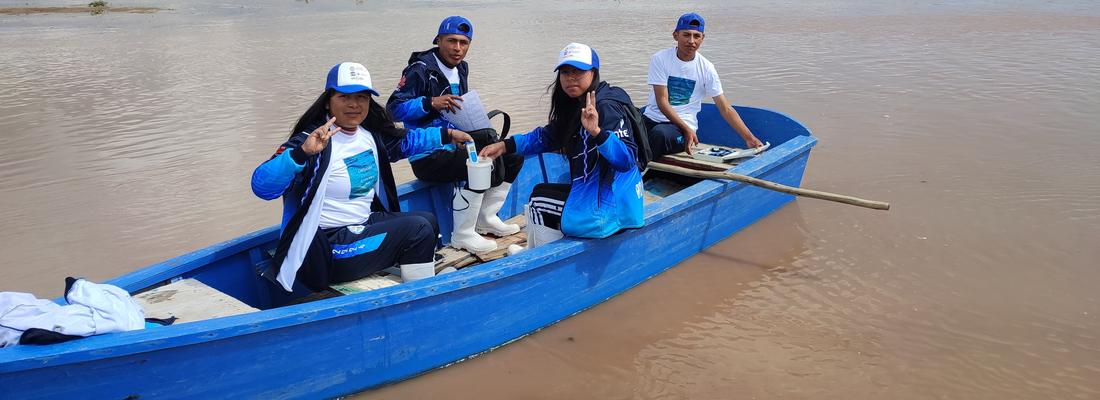
Developed and implemented in collaboration with four Indigenous communities in Chojasivi and the Bolivian Catholic University, and the Vrije Universiteit Brussel (VUB), this project undertakes a comprehensive effort to assess and better understand the water quality challenges affecting Lake Titicaca. Citizen science methodologies guide the work, with community members actively engaged in water quality monitoring, including data collection, analysis, and the joint interpretation of results.
The project is grounded in collaboration, and respect for Indigenous knowledge systems. Close partnership with the communities of Chojasivi strengthens locally generated evidence on water quality dynamics, supports mutual learning between communities and researchers, and contributes to the empowerment of Indigenous peoples in advocating for their environmental rights and water justice.
Aim
To generate robust, community-driven evidence on water quality and environmental injustices in Lake Titicaca through citizen science, while examining how participatory monitoring can strengthen Indigenous environmental justice advocacy and support locally grounded water governance
Impact and insights
Established a community-based citizen science monitoring initiative in Lake Titicaca in collaboration with four Indigenous communities in Chojasivi and the Bolivian Catholic University. Generated locally grounded water quality data across multiple monitoring sites and campaigns, covering key physicochemical parameters (pH, PO₄, NO₃, EC, turbidity, TDS, temperature). Strengthened community capacity in water quality monitoring through hands-on training in sampling, data collection, and basic interpretation. Integrated Indigenous knowledge into the assessment through focus group discussions, enabling the documentation of local environmental observations and community interpretations of water quality change. Supported evidence generation on environmental injustices by linking monitoring results with community-identified pollution pressures, lived experience, and local narratives. Fostered mutual learning and sustained collaboration between Indigenous communities, university researchers, and students. Contributed to community empowerment by strengthening the evidence base available for environmental justice advocacy and water justice claims. A key challenge was ensuring the accurate registration of GPS coordinates for the sampling points. During the first monitoring campaigns, several errors were identified in the recorded coordinates, which affected the reliability of site identification. To address this, a quality control process was implemented to verify coordinate consistency, and datasets with unreliable location information were discarded. In subsequent campaigns, additional guidance and supervision were provided during fieldwork to strengthen accuracy in coordinate recording. What is special about this project is that it went beyond water quality monitoring and created a meaningful intergenerational dialogue on environmental justice, ecological change, and the loss of ecosystem services. Many of the participating Indigenous senior high school students have grown up under conditions of severe pollution and persistent hypereutrophication, meaning they have no alternative reference point for what the river ecosystem used to be. As a result, living near a heavily polluted river had become normalized. Through interviews and reflective discussions, the project revealed an important shift: several students began engaging older generations to ask about past river conditions and the benefits the community previously received from the river. This intergenerational exchange helped revive ecological memory and supported a deeper understanding of the environmental problem as historically produced and socially unequal.Organisations
Project data
No published data has been added to this project yet.